A game-playing agent for Pokémon TCG
An AlphaGo-style agent for a card game with hidden information: learned policy, learned evaluation and search over the turn.
The problem
A Kaggle competition by The Pokémon Company: build an agent that plays full games of the trading card game in a simulator. Unlike Go, most information is hidden and one turn can contain dozens of chained decisions.
How it works
- Game statesimulator observation, hidden cards unknown
- Policyproposes the most promising actions
- Beam searchexplores sequences within the turn under a clock
- Evaluationscores the resulting positions
- Actionbest line is played
What I learned
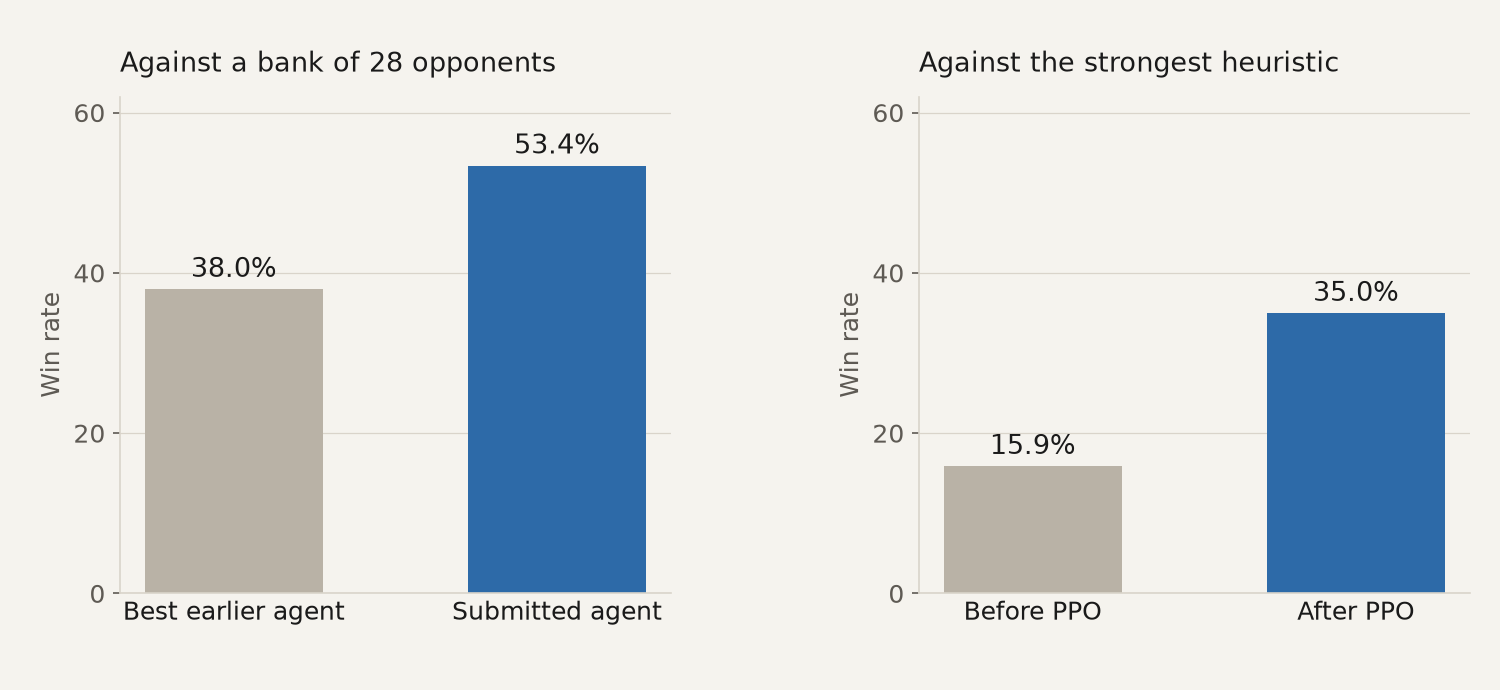
After submission I kept testing the opposite hypothesis. The bottleneck was never the evaluator: it was the policy. Retraining the policy with PPO broke a ceiling that no amount of search had moved (15.9% → 35.0% against the strongest heuristic opponent, z = +7.75). The path of improving the evaluator was closed with a mechanism: its training label was degenerate (only 0.318% of search paths ended in a win).
The strategy write-up for the competition adapts the AlphaGo recipe to a game with hidden information, and documents what transferred and what did not.