02  ·  Computer vision · Tennis · 2026

TennisVision

From a single broadcast feed to shot-by-shot tennis data: every shot, every bounce, the ball in 3D.

Watch the live board ↓Open the product demo ↗Technical write-up ↗
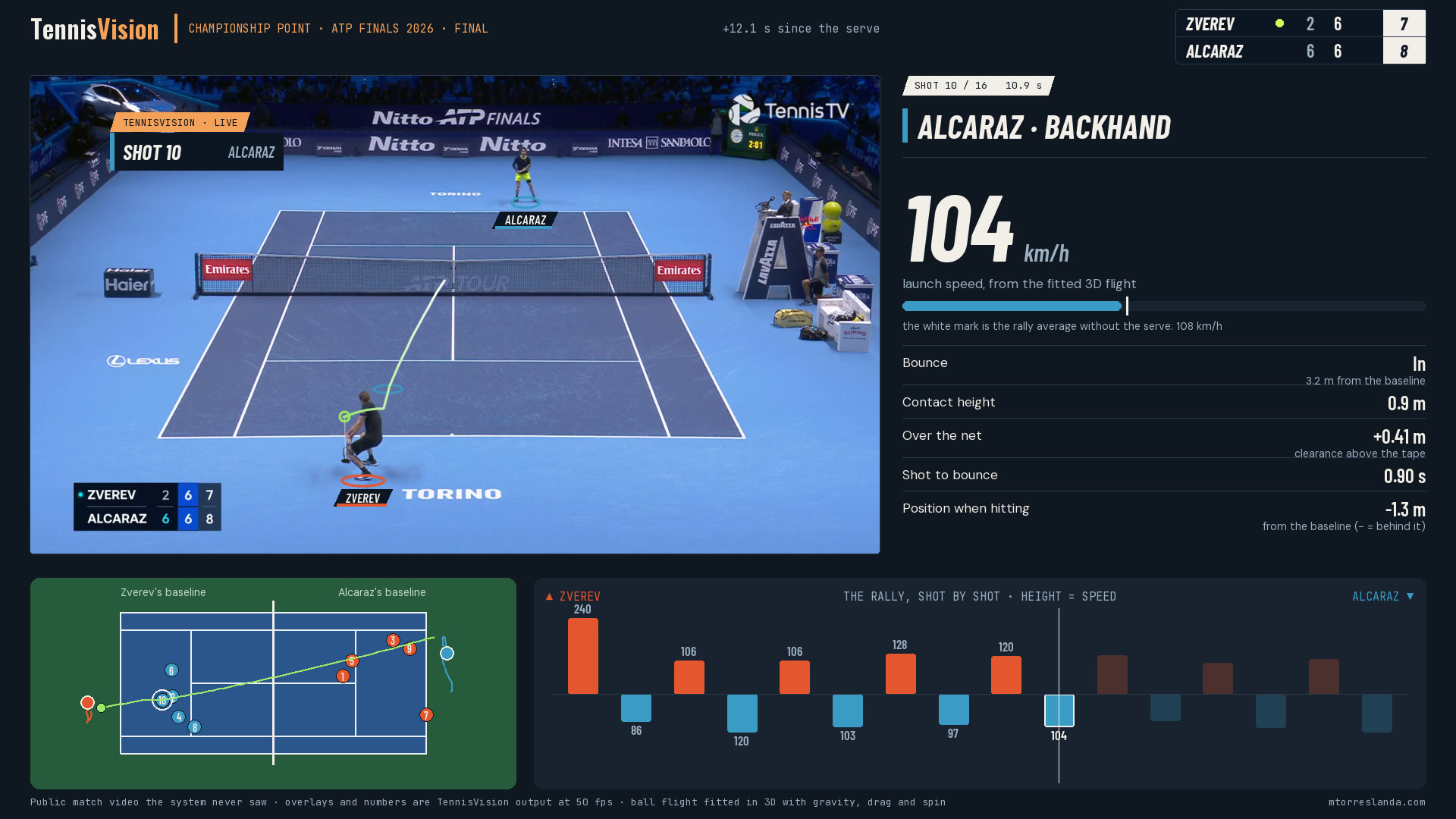
Fig. 1  Live board, championship pointATP Finals 2026 · Alcaraz vs Zverev · public video, never seen by the model
96%of 3,199 hand-checked shots and bounces detected
99.5%of serves found
97%points read without a single error on matches it never saw
0.68 pxcourt error against the painted lines; the off-the-shelf model: 2.11
01 · The problem

Shot data lives at a handful of venues.

Where every ball bounced, how fast it was hit and from where: that data comes from multi-camera systems installed at a few courts. Broadcast video exists for every match.

02 · What it does

One TV camera in, every shot out.

TennisVision finds the players, the court and the ball, times every shot and bounce, and rebuilds the ball's flight in 3D, fifty times a second.

03 · The proof

On a final it had never seen.

The point above is the last of the 2026 ATP Finals, from a public upload published after every model was trained. No ground truth behind it, no help.

Try it

Replay the point

This is what TennisVision measured on the championship point, drawn from the same data that is published on GitHub. Press play, or pick a bounce or a bar to see that shot.

Fig. 2  The point from aboveTracking at 50 Hz ↗  ·  Every shot and bounce ↗

There is a product demo too. The same data as a broadcast product: the pipeline step by step on one frame, the court explorer full size, and the board.

Open the product demo →
How it works

Seven stages, one measurement each
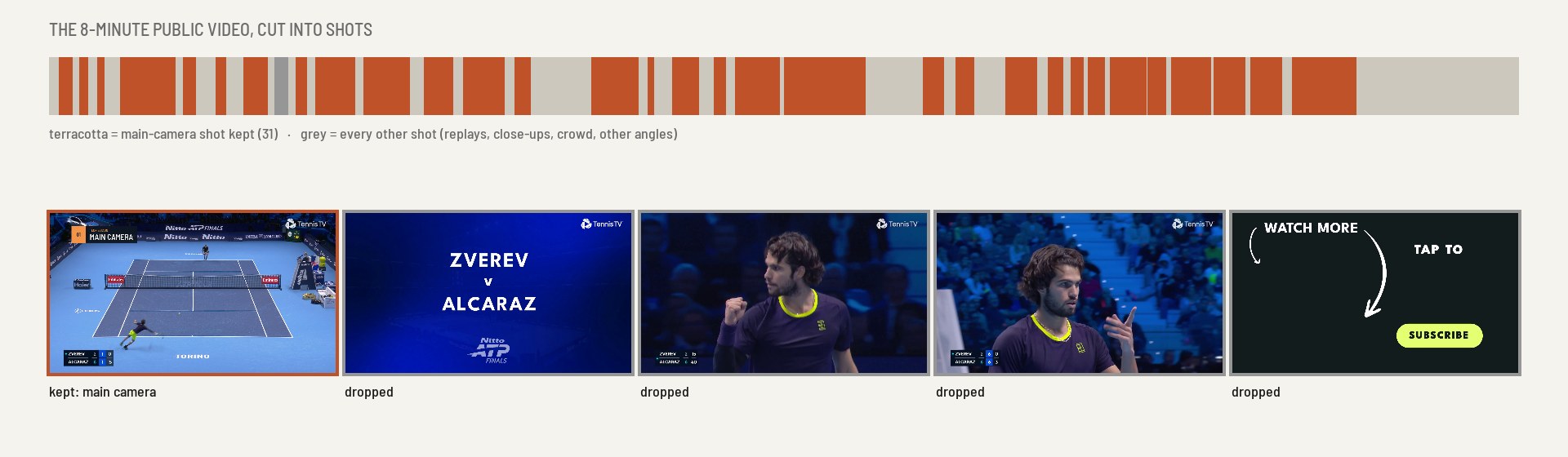
Fig. 3  Scenes
  1. 01 / 07

    Scenes

    The broadcast is cut into shots. Only those where the court is seen from the main camera are kept, and the scoreboard is read with OCR.
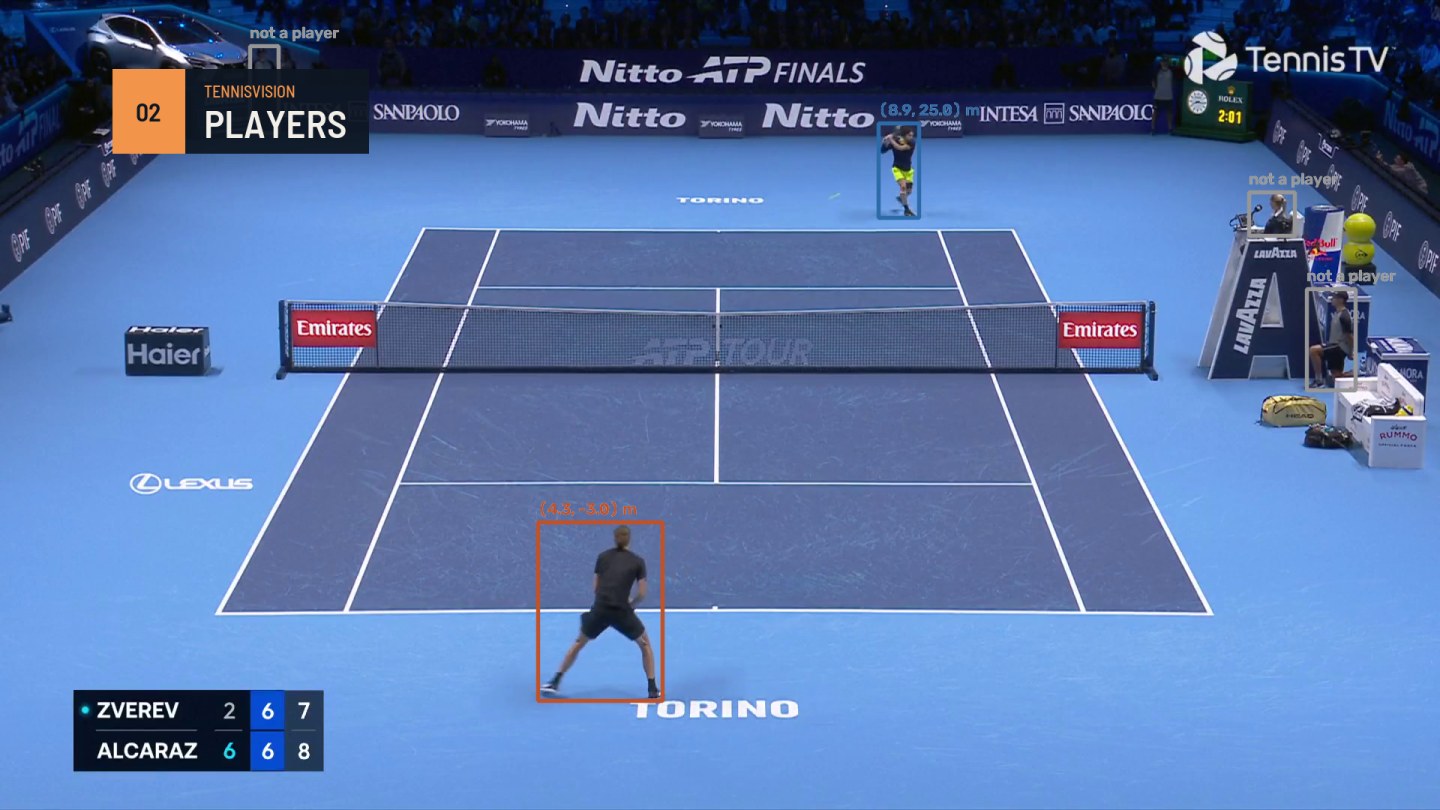
  2. 02 / 07

    Players

    A transformer detector finds every person; a filter keeps the two players and drops the umpire, line judges and ball kids. Their feet go onto the court, in metres.
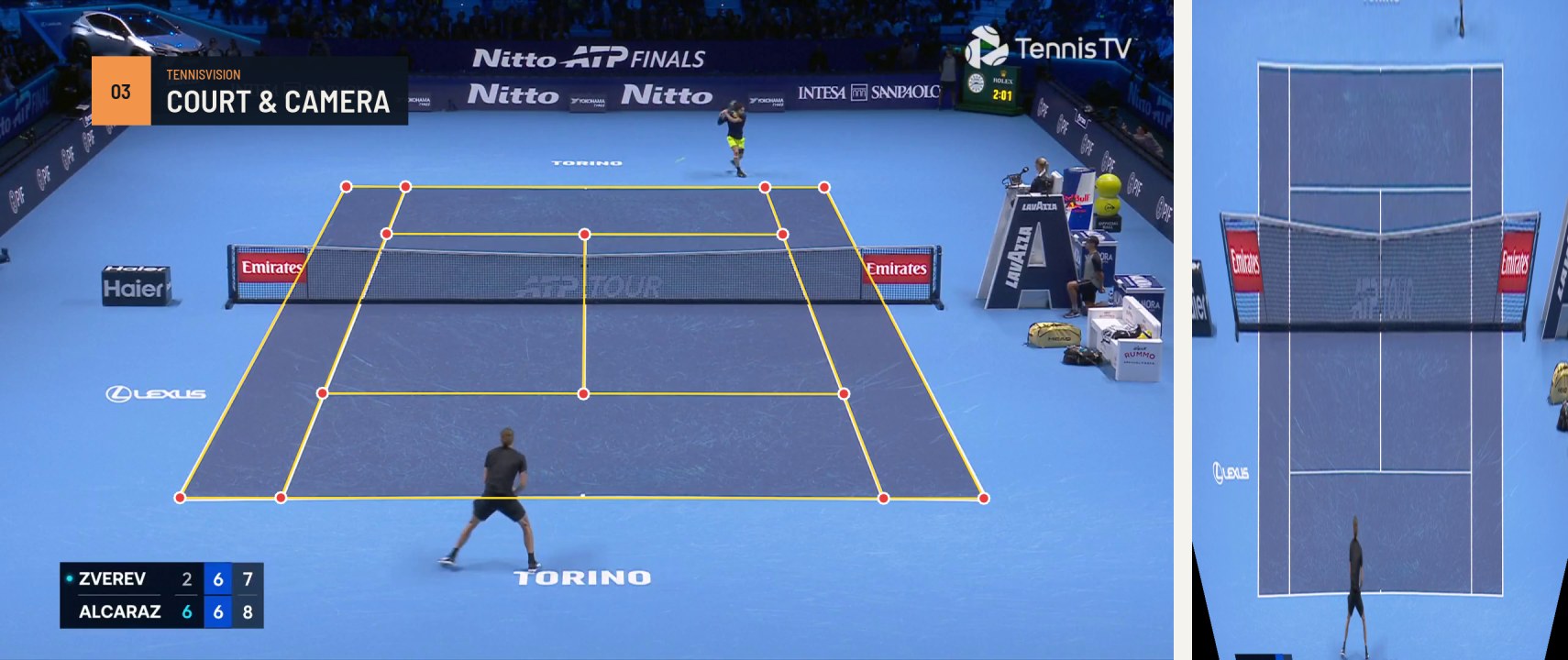
  3. 03 / 07

    Court and camera

    A keypoint network, trained from scratch, finds the 14 line intersections in every frame: a homography for the ground and a 3D camera that pans and zooms.
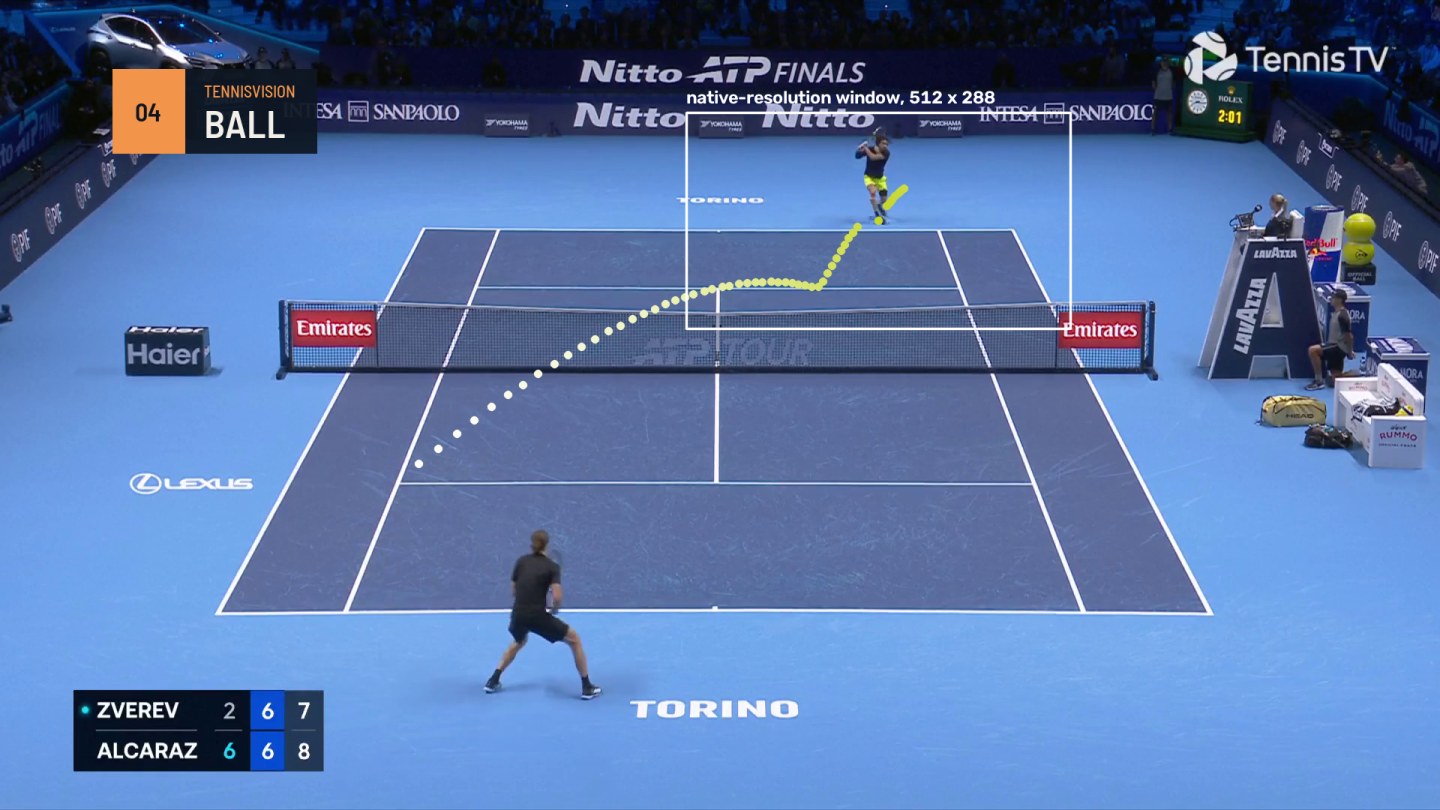
  4. 04 / 07

    Ball

    Two convolutional heatmap networks: one scans the whole frame, the other looks again at native resolution around the ball's predicted path.
  5. 05 / 07

    Events

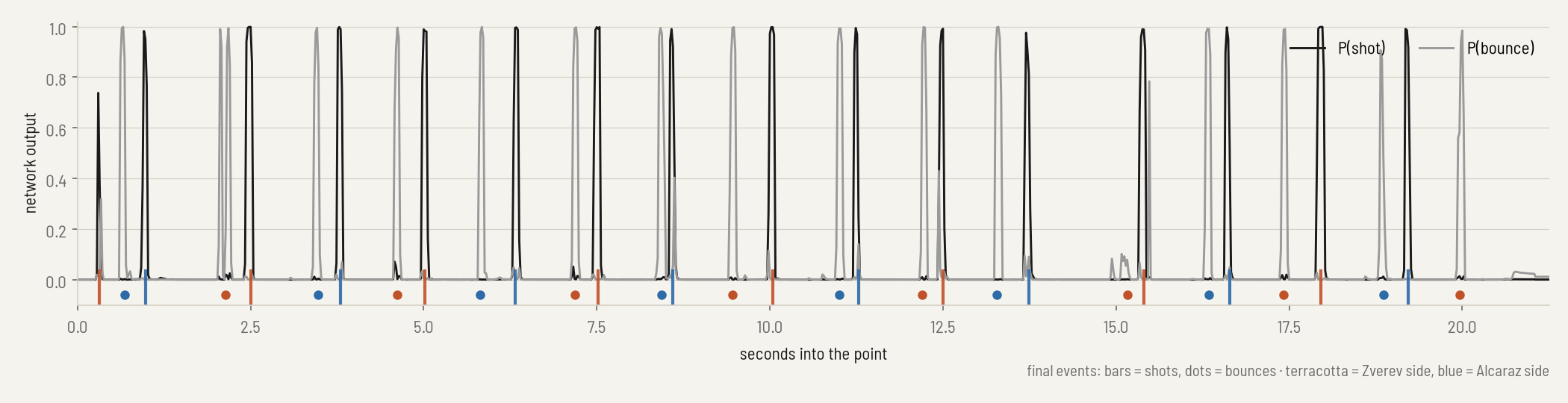
    A video network that fuses image and sound, the crack of the racket and the thud of the bounce, gives the probability of a shot and of a bounce in every frame.
  6. 06 / 07

    Rules and physics

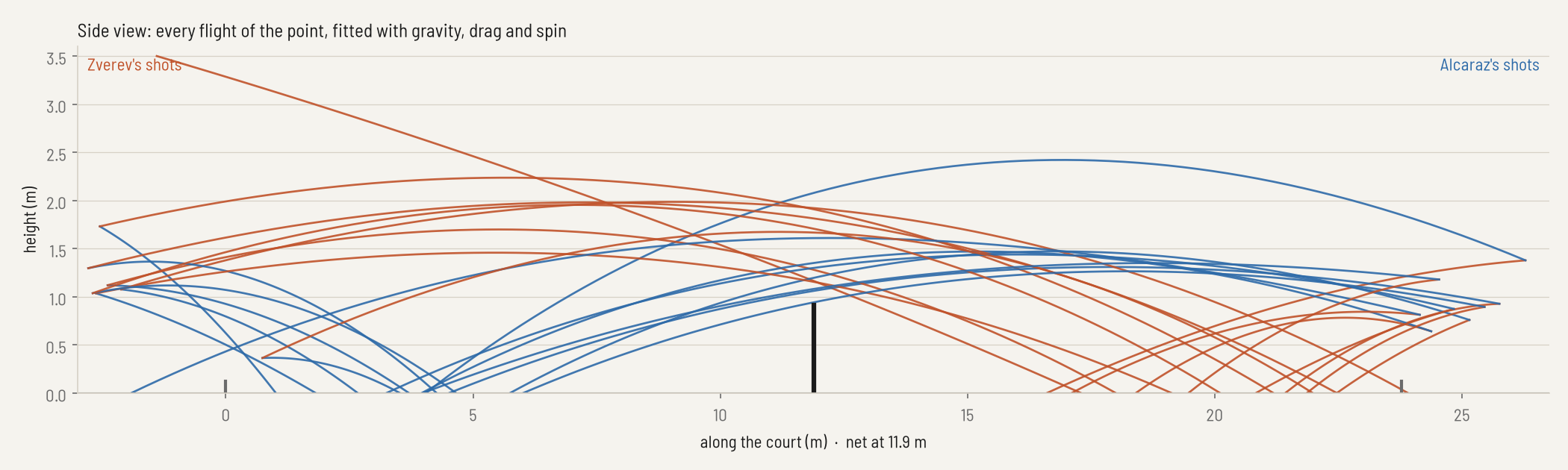
    A decoder that knows the rules turns probabilities into tennis. Then every flight is fitted in 3D with gravity, drag and spin, through the moving camera.
  7. 07 / 07

    Analytics

    Speed, contact height, clearance over the net, depth, in or out, and how far each player ran: shot by shot, as the point unfolds.

Results

Measured shot by shot

On 439 points reviewed by hand, 3,199 shots and bounces, from four matches on hard, clay and grass.

Events
96% of real shots and bounces detected
Serve
99.5% of serves found
Unseen matches
97% of points read without a single error, clay and grass included
Rules layer
errors on 439 points cut from 195 to 144
Court
0.68 px from the painted lines; the off-the-shelf model, 2.11 px
Serve speed
median error 9.5 km/h against the official radar display
In progress

Club tennis, one fixed camera.

The same idea for amateur matches filmed with a single fixed camera and no scoreboard: the score, the stats and the highlights, built automatically. Rallies are already cut by detecting the serving pose (56 of 57 serves found), and given who wins each point the score comes out right: 38 of 38 points and the 6–0 set.